
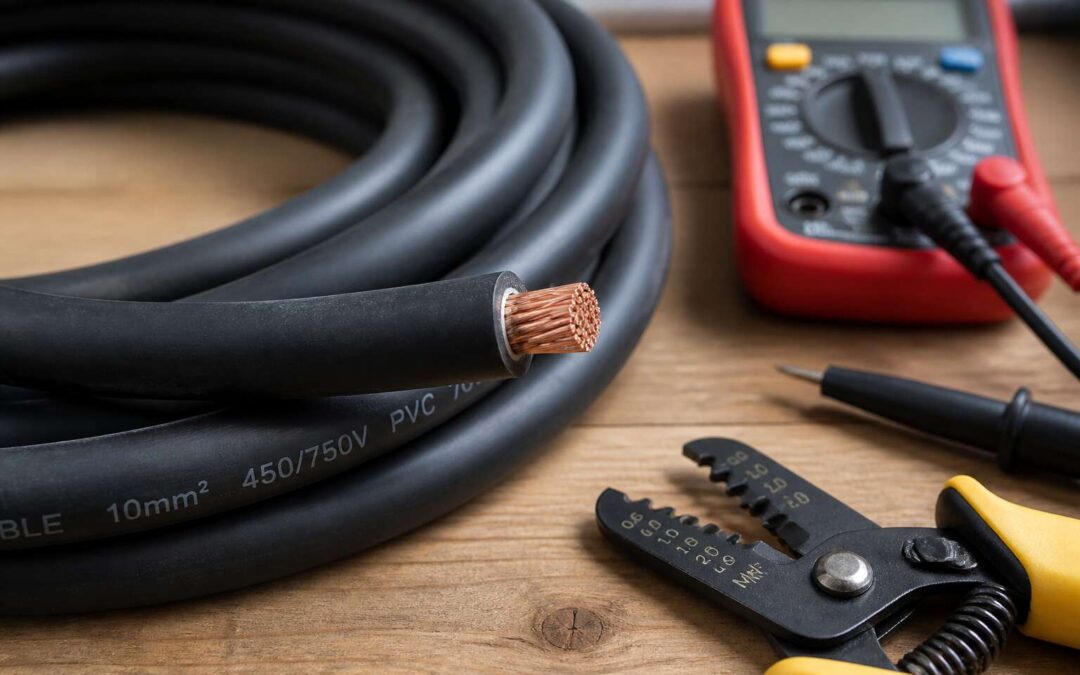
Understanding Cable Sizing and the 10mm Conductor
What Does 10mm Cable Refer To?
Cable sizing is a dark art, where the difference between a safe installation and a smouldering failure lies in a single number. The 10mm conductor represents a specific cross sectional area, a measure that dictates current carrying capacity. When we speak of electrical cable 10mm, we refer to the copper core’s thickness, not the outer insulation.
This size is common in South African homes for heavy loads. It handles roughly 50 to 63 amps depending on installation method. A 10mm cable powers stoves, geysers, and sub circuits. Yet the true character of that conductor reveals itself only under stress.
- Voltage drop over distance must be calculated.
- Thermal insulation around the cable reduces capacity.
- Terminal connections need proper torque.
The number 10mm is a promise, a physical truth, yet many ignore its limits. Overloading that conductor invites heat, then fire. Understand the metal before you trust it.
Common Applications for 10mm Conductors
Cable sizing is a calculation of consequences. The electrical cable 10mm must be matched to the load it serves, but also to the path it travels. A conductor buried in insulation or bundled with others loses capacity fast! SANS 10142-1 provides correction factors, but they only work if someone actually applies them. I have seen too many installations where the guesswork resulted in a warm wall.
That is why the 10mm conductor earns its place in specific roles. In a typical South African home, you will find it feeding:
- Single and double ovens drawing up to 40 amps
- Geyser circuits with high-resistance elements
- Sub-distribution boards for outbuildings or garages
- Air conditioners on dedicated runs
These appliances draw high current for extended periods. The 10mm copper core holds its rating under continuous demand, making it the standard choice for these installations.
Key Advantages and Limitations
Cable sizing is the fundamental calculation behind every safe circuit. For the electrical cable 10mm, the calculation hinges on voltage drop, ambient temperature, and installation method. A conductor that performs admirably in free air may overheat when buried in conduit or wrapped in insulation. In my experience, SANS 10142-1 provides derating factors, but these tables reward careful reading.
The 10mm copper conductor offers a balanced profile. Its current-carrying capacity suits demanding fixed loads, yet physical stiffness introduces practical constraints. Pulling this cable through tight bends requires patience. Termination points must accommodate its cross-section, and protective devices must match its rating precisely.
- Voltage drop over extended distances reduces delivered power
- Thermal insulation around the cable lowers its ampacity
- Bundling conductors creates cumulative heat
These factors determine whether the electrical cable 10mm delivers its full potential. The limitation lies not in the copper, but in the environment we place it in.
How 10mm Cable Compares to Other Metric Sizes
Every metric cable size represents a compromise in copper. The electrical cable 10mm sits at a peculiar threshold. Smaller sizes like 2.5mm and 6mm bend easily but falter under load. Larger conductors such as 16mm and 25mm carry current with grace, yet their rigidity demands brutal installation effort. The 10mm cable occupies a middle ground that electricians respect or despise.
A 10mm conductor offers roughly 40 percent more copper than a 6mm cable. That additional metal lowers resistance and operating temperature. Yet the comparison grows murky when installation conditions enter the equation, as I have witnessed on more than one site!
- Buried in earth, ampacity falls to soil thermal resistance
- Clipped to a surface, it nears its theoretical maximum
- Enclosed in conduit, derating curves punish its surface area
Each metric size carries its own spectral signature of compromise. The electrical cable 10mm demands that you read the tables with reverence.
Electrical Ratings and Performance Characteristics
Current Carrying Capacity (Ampacity)
Ambient temperature in South African installations routinely exceeds 30°C, a number that reshapes how the electrical cable 10mm delivers current. Ampacity, or current carrying capacity, is not a fixed value etched into the conductor. It emerges from thermal equilibrium: the cable sheds heat while the environment absorbs it. When that balance tips, performance drops.
Installation conditions dictate the real limits. I have seen cables in buried conduits derated severely compared to open clipped runs. Grouping circuits adds further strain, and SANS 10142-1 offers reference tables that assume specific conditions.
Derating factors to respect:
– Ambient temperature corrections
– Thermal conductivity of soil
– Proximity of other loaded cables
– Depth of installation
Each factor adjusts the permissible load, turning a theoretical number into a practical ceiling. The 10mm conductor, then, behaves as a responsive system rather than a static component.
Voltage Drop Over Distance
At 32 A, a thirty metre run of electrical cable 10mm gives away roughly four volts before the load ever sees them. When I size a circuit, the round trip distance comes first. Voltage drop follows that length, and the lost energy turns into heat. SANS 10142-1 caps lighting circuits at 5% and other loads at 7%. Exceed those limits and the cable becomes the weak point.
The longer the cable, the more it resembles a resistor. That heat compounds the ampacity concerns discussed earlier.
Consequences of excessive drop:
- Lamps dim noticeably
- Motors draw more current and run hot
- Electronic controls reset or misbehave
The electrical cable 10mm performs well when the mV/A/m figure matches the installation method and the run stays within the calculated reach.
Insulation Types and Temperature Ratings
Insulation defines how the electrical cable 10mm endures heat. South African installations commonly use PVC, which tolerates 70°C on the conductor. XLPE insulation steps up to 90°C, a margin that matters when the electrical cable 10mm runs through warm roof spaces or bunched with other circuits. The temperature rating directly changes which ampacity column you read.
The sheath markings reveal the performance boundaries:
1. PVC insulation: 70°C maximum conductor temperature
2. XLPE insulation: 90°C maximum conductor temperature
3. Rubber insulation: flexible but lower heat tolerance
The voltage rating belongs to the insulation as well. Most 10mm cable reads 600/1000V, meaning 600V to earth and 1000V between phases. That covers standard South African supply voltages. The insulation type and temperature rating form the boundary conditions for every circuit design.
Short-Circuit and Overload Capacity
A cable’s true character reveals itself under fault conditions. When a short circuit occurs, the electrical cable 10mm must endure a violent surge of current until the protective device clears the fault. Short-circuit withstand depends on conductor mass and insulation type. Copper conductors absorb significant fault energy briefly, but the clearing time matters more than the raw current magnitude.
Overload capacity is a different matter. A persistent overcurrent heats the conductor gradually, and the insulation determines how long the cable survives. PVC insulation tolerates less sustained overload than XLPE versions, which is why designers must match the breaker rating carefully.
Consider these coordination points:
– The let-through energy rating, or I²t, defines safe fault duration
– Protective devices must interrupt before insulation reaches critical temperature
– The thermal time constant of the electrical cable 10mm influences breaker selection
Protective devices and conductor ratings operate as a matched system. Designers calculate prospective fault current to confirm the electrical cable 10mm withstands it without permanent damage.
Installation Guidelines and Safety Considerations
When to Choose 10mm Cable for Circuits
Installing an electrical cable 10mm demands respect for local regulations and a clear head. In South Africa, the Wiring Code (SANS 10142) governs most residential and commercial work, so a certified electrician should handle any permanent connection. Not merely a matter of tightening terminals, the physical routing matters: sharp bends stress the conductor, and proximity to heat sources derates its capacity. You must also account for the cable’s mass and stiffness when pulling it through conduit.
Safety hinges on proper protection and termination. For instance:
– Use appropriate glands and lugs to prevent corrosion at connections.
– Ensure the protective device matches the cable’s ampacity, not the appliance’s rating.
– Verify earth continuity and insulation resistance before energising.
Choosing an electrical cable 10mm for circuits that exceed a 32A draw is prudent, but only if the installation allows adequate ventilation and short runs. Otherwise, even a correctly sized conductor poses risk.
Proper Termination, Crimping, and Jointing
Proper termination of an electrical cable 10mm involves more than tightening a screw. The conductor strands must sit fully inside the lug barrel, with no stray wires exposed. Crimping requires the correct die set; using the wrong size weakens the mechanical bond. Jointing carries similar risk. A poorly executed splice in a buried cable can become a future fault point, especially under high ambient temperatures typical of South African summers.
Follow these checks for every connection:
- Strip the insulation to the exact lug depth.
- Crimp in a single compression stroke, never re-crimp.
- Torque the terminal screw to the manufacturer’s specification.
Heat shrink or cold shrink sleeves provide additional strain relief and moisture protection. Remember that a terminated electrical cable 10mm is only as safe as its weakest point. One corroded joint can derate the entire circuit, so seal all entry points against dust and water.
Regulatory Compliance and Wiring Standards
Every permanent electrical installation in South Africa answers to SANS 10142-1. This wiring code governs how an electrical cable 10mm is run, supported, and protected. It specifies the colour coding, bending radius, and the coordination between the circuit breaker and the conductor’s ampacity. Non-compliance often surfaces during property inspections, delaying sales and voiding insurance claims.
For domestic and light commercial work, the following requirements apply:
- Secure the electrical cable 10mm with approved saddles at 300mm intervals along horizontal runs.
- Keep the bending radius above 8 times the cable diameter.
- Route the cable away from data lines to prevent induced interference.
The Certificate of Compliance is the legal proof that the work meets SANS 10142-1 and municipal bylaws. Without it, municipalities can order the installation to be reopened for inspection. For a circuit carrying the current a 10mm conductor can supply, the margin for error is small.
Comparing 10mm Cable with Other Gauges
10mm vs 6mm vs 16mm – Core Differences
Three gauges dominate South African wiring shelves: 6mm, 10mm, and 16mm. The electrical cable 10mm holds the middle ground. A 6mm wire bends into tight corners but restricts power flow. A 16mm conductor resists bending, demanding wide radii and sturdy fasteners.
- 6mm: thin insulation, light duty circuits only.
- 10mm: balanced cross section for general power.
- 16mm: thick copper, heavy industrial feeders.
That physical difference alters termination methods. Screw terminals grip 10mm cleanly, while 16mm often requires crimped lugs and hydraulic presses. For South African installations, the 10mm choice avoids the stiff handling of 16mm and the wiring limits of 6mm.
Selecting the Right Cable for Your Load
A single 9.5kW geyser draws close to 40 amps on a 230V supply. That load demands more than a 4mm conductor can safely carry, yet a 16mm cable adds unnecessary cost and bending struggle. The electrical cable 10mm sits exactly where most residential and light commercial loads fall.
Selecting the right cable for your load comes down to three checks:
- Continuous current draw, not just the breaker rating.
- Route length, because voltage drop climbs with every meter.
- Ambient temperature, which derates the conductor.
For a typical South African installation, the electrical cable 10mm handles 40 to 63 amp breakers depending on installation method. It feeds stoves, geysers, and sub-distribution boards without the stiffness of 16mm. When your load calculation lands between 35 and 55 amps, stop second-guessing and pick this size!
Cost, Availability, and Practicality
Nobody enjoys paying for copper they will never use. In South Africa, the electrical cable 10mm costs roughly a third more than 6mm, but it often comes in at less than half the price of 16mm. That gap becomes obvious when you run a 20 metre route to a sub-distribution board.
Availability is rarely a struggle. Reputable wholesalers, from Voltex to ARB, keep the electrical cable 10mm in regular stock. You will not wait days for a special order the way you might with less common conductor sizes.
- Cost: cheaper than 16mm, heavier than 6mm on the budget
- Availability: off the shelf at most major electrical suppliers
- Practicality: bends into confined spaces without wrestling matches
Practicality carries real weight. A 16mm conductor fights you at every termination point. The electrical cable 10mm slides comfortably into 25mm conduit and pairs with standard lugs. For most residential and light commercial installations, that balance of price and handling is the reason it stays popular.
Future-Proofing with Larger Conductors
Future-proofing means buying cable for electrical loads you have not even dreamed up yet. The electrical cable 10mm handles today’s demand with ample headroom, but South African property owners tend to add equipment within five years:
- Solar inverter or battery storage
- Induction hob or heat pump
- Outdoor workshop sub-panel
A 6mm conductor will require replacement when those loads land. A 16mm conductor costs nearly double and resists bending at every termination point, yet it offers genuine headroom. The electrical cable 10mm occupies the practical middle, handling current loads while preserving an upgrade path that avoids opening the wall again. Future-proofing rarely means buying the largest option available. It means choosing a conductor that lets you expand without a full rewire or a fistfight with a conduit.
Sourcing, Quality, and Certification
Copper vs Aluminium Conductors
Sourcing a 10mm electrical cable means deciding between copper and aluminium conductors. In South Africa, copper remains the preferred conductor for its superior conductivity, but aluminium offers a lighter and often more affordable alternative. The quality of the metal matters immensely. Impurities in either conductor increase resistance and generate heat, which compromises safety.
When I inspect a reel, I verify a few details before trusting it:
- The conductor’s gauge and stranding consistency
- The sheath’s printing for the SABS mark and date of manufacture
- The supplier’s traceability documentation
Certification is the safeguard. A certified electrical cable 10mm ensures that the copper or aluminium inside has been tested for purity and performance under SANS 1507. Without proper certification, you risk installing an electrical cable 10mm that fails under load.
Important Certifications and Markings
A counterfeit electrical cable 10mm can look identical to a certified product. The difference sits in the printing on the sheath. In South Africa, the NRCS requires a compliant electrical cable 10mm to display a valid Letter of Authority number alongside the SANS 1507 reference. When those markings are absent, or simulated, the cable becomes a counterfeit with unknown endurance thresholds.
I have unrolled reels where the print repeated cleanly for fifty metres, then vanished on the final length. That inconsistency exposes a manufacturer reducing material costs. The legitimate product remains uniform from first metre to last.
The sheath of a compliant reel carries these elements:
- The SABS mark or NRCS Letter of Authority number
- The SANS 1507 specification reference
- The conductor size and manufacture date
- A traceable batch code
Without that certification, legal accountability disappears.
Testing and Quality Assurance
Sourcing the raw copper for an electrical cable 10mm sets the entire reliability chain in motion. I have walked through mills where the conductor arrives with a mill certificate, but the true test comes later! Quality assurance demands more than paperwork; it demands destructive sampling.
The manufacturing line pulls the conductor through a drawing die, then anneals it under precise heat. A single impurity in the copper can create a hot spot that fails under load. That is why reputable suppliers send every reel through a sequence of checks.
Here is what the testing regimen looks like for a compliant electrical cable 10mm:
- Conductor resistance measurement, verified against SANS 1507 limits
- Insulation thickness and eccentricity checks under magnification
- High-voltage spark testing to detect pinholes or voids
- Tensile and elongation tests on the sheath after ageing
Each of these procedures takes minutes, but the data follows the reel for years. When a batch fails, it is destroyed, not discounted. That is the difference between a product that endures and one that merely exists.
Trusted Brands and Suppliers
Sourcing a compliant electrical cable 10mm starts with a supplier’s willingness to expose their process. I have visited local distributors who stock imported reels without a single traceable document. That is a clear warning sign!
Trusted brands share their mill certificates, batch numbers, and test data without prompting. They also hold SABS accreditation and can explain what their markings mean. A supplier who cannot answer basic questions about conductor stranding or sheath compound probably cannot guarantee consistency.
Consider what separates reliable suppliers:
– They provide full traceability from copper source to final drum
– They stock locally, reducing the risk of counterfeit reels
– They offer technical support from engineers, not just sales staff
Certification is not decoration. It is the visible evidence of an invisible process. The suppliers who endure understand this. Their electrical cable 10mm arrives with paperwork that tells a complete story from mine to installation.