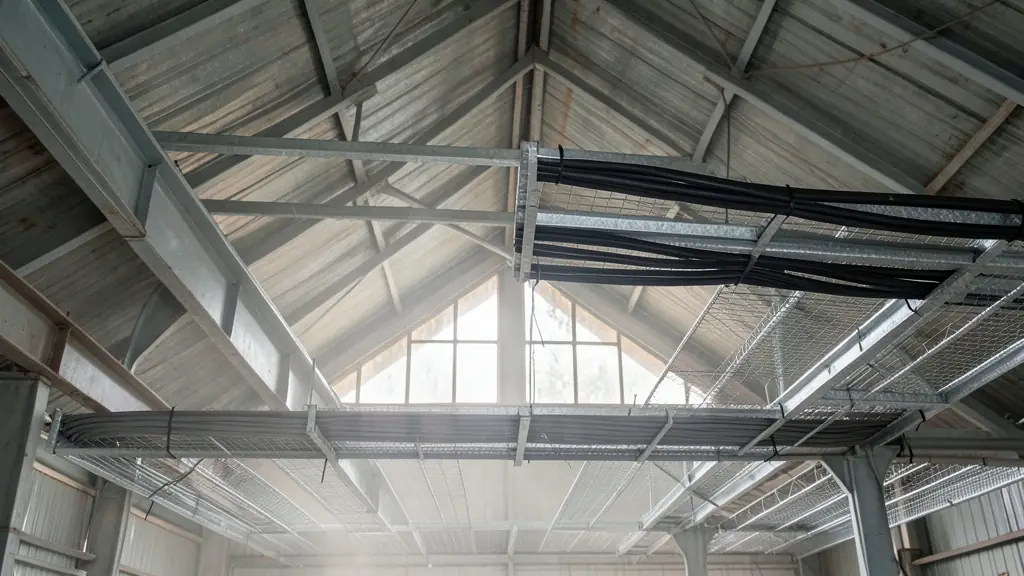
When a building has more cables than a few clips can hold, cable tray keeps them supported, separated and easy to reach. It is the standard way to run power and data cables through factories, warehouses, offices, plant rooms and large solar installs. ElectricalCable.co.za is a free quote-request service: tell us what cable tray you need, the sizes and lengths, and where the job is, and we pass your request to an independent electrical wholesaler or contractor in your area. They quote you directly. We do not stock or sell tray ourselves, and there is no obligation to accept.
Types of cable tray
Choosing the right style of cable tray depends on the cable weight, the span between supports and how much airflow and access you need:
- Ladder tray: two side rails joined by rungs, strong over long spans and best for heavy armoured mains and sub-mains
- Perforated (punched) tray: a flat base with slots, good for medium cables and lots of smaller runs
- Wire mesh cable tray: also called basket tray, light and quick to cut and bend on site, popular for data and low-current cables
- Solid-bottom tray and trunking: fully enclosed where cables need protection from dust or damage
Cable tray sizes and fittings
Common cable tray sizes run from narrow 50 mm or 100 mm widths for a handful of cables up to 600 mm and wider for main plant rooms, with different side heights for deeper loads. Straight lengths usually come in 2.4 m or 3 m sections. A tidy job also needs matching bends, tees, risers, reducers, couplers and covers, plus brackets, cantilever arms, threaded rod and fixings. Leave space for future cables: a tray packed full on day one cannot take an extra circuit later, and tightly bunched cables run hotter.
Galvanised, stainless or fibreglass
Most indoor cable tray is pre-galvanised steel, which is fine for dry offices and warehouses. Outdoors, in plant rooms and on mines, hot-dip galvanised tray lasts far longer. On the coast or in chemical and food plants, stainless steel or GRP (fibreglass) tray resists corrosion best. Bolts and brackets should match the tray, because mixing metals speeds up rust. Metal cable tray must also be bonded to earth, which your electrical contractor will handle as part of a compliant SANS 10142-1 installation.
What affects cable tray price
The cable tray price depends on the type, width and side height, the steel thickness, the finish, and how many fittings and supports the route needs. Steel prices move, so suppliers quote per job rather than from a fixed list. Delivery to site, cutting and whether you want supply only or a contractor to install the tray and pull the cable also change the total. Send a drawing or a sketch with lengths and you will get a far more accurate quote.
Comparing cable tray prices
Cable prices change with the copper price, size, brand and quantity. When quotes arrive, check:
- Exact specification: size in mm², cores, conductor, insulation, armour and voltage rating.
- Quantity: cut length or full drum, and whether the drum deposit is refundable.
- Standards: SABS-marked cable to the relevant SANS standard, not unmarked imports.
- Delivery: lead time, delivery to site and offloading of heavy drums.
What to include in your request
- Type of tray (ladder, perforated or wire mesh) and the finish
- Width, side height and total length needed
- Number of bends, tees, risers and covers, or a drawing
- Indoor, outdoor or coastal location and the support method
- Supply only or supply and installation, plus delivery address
Frequently asked questions
Do you sell cable tray?
What is the difference between ladder tray and wire mesh cable tray?
Can power and data cables share the same cable tray?
How do I know what width of cable tray I need?
Cable Tray by province
- Cable Tray Gauteng
- Cable Tray Western Cape
- Cable Tray KwaZulu-Natal
- Cable Tray Eastern Cape
- Cable Tray Free State
- Cable Tray Limpopo
- Cable Tray Mpumalanga
- Cable Tray North West
- Cable Tray Northern Cape
Cable Tray by city
- Cable Tray in Johannesburg
- Cable Tray in Pretoria
- Cable Tray in Centurion
- Cable Tray in Sandton
- Cable Tray in Midrand
- Cable Tray in Randburg
- Cable Tray in Roodepoort
- Cable Tray in Alberton
- Cable Tray in Boksburg
- Cable Tray in Kempton Park
- Cable Tray in Benoni
- Cable Tray in Germiston
- Cable Tray in Krugersdorp
- Cable Tray in Vereeniging
- Cable Tray in Vanderbijlpark
- Cable Tray in Cape Town
- Cable Tray in Bellville
- Cable Tray in Kuils River
- Cable Tray in Somerset West
- Cable Tray in Paarl
- Cable Tray in Stellenbosch
- Cable Tray in George
- Cable Tray in Mossel Bay
- Cable Tray in Worcester
- Cable Tray in Durban
- Cable Tray in Pinetown
- Cable Tray in Pietermaritzburg
- Cable Tray in Richards Bay
- Cable Tray in Ballito
- Cable Tray in Margate
- Cable Tray in Newcastle
- Cable Tray in Port Elizabeth (Gqeberha)
- Cable Tray in East London
- Cable Tray in Bloemfontein
- Cable Tray in Welkom
- Cable Tray in Polokwane
- Cable Tray in Tzaneen
- Cable Tray in Nelspruit (Mbombela)
- Cable Tray in Witbank (eMalahleni)
- Cable Tray in Middelburg
- Cable Tray in Secunda
- Cable Tray in Rustenburg
- Cable Tray in Klerksdorp
- Cable Tray in Potchefstroom
- Cable Tray in Kimberley
- Cable Tray in Upington
Related cable and services
- AC-02Electrical ConduitRigid PVC conduit in 20, 25, 32, 40 and 50 mm
- EC-05Armoured Cable (SWA)PVC/SWA/PVC or XLPE/SWA/PVC, 600/1000 V
- EC-15Data and Network CableCat5e, Cat6 and Cat6a four-pair twisted-pair cable
- SV-01Electrical Cable InstallationLighting, plug, stove, geyser and dedicated appliance circuits